
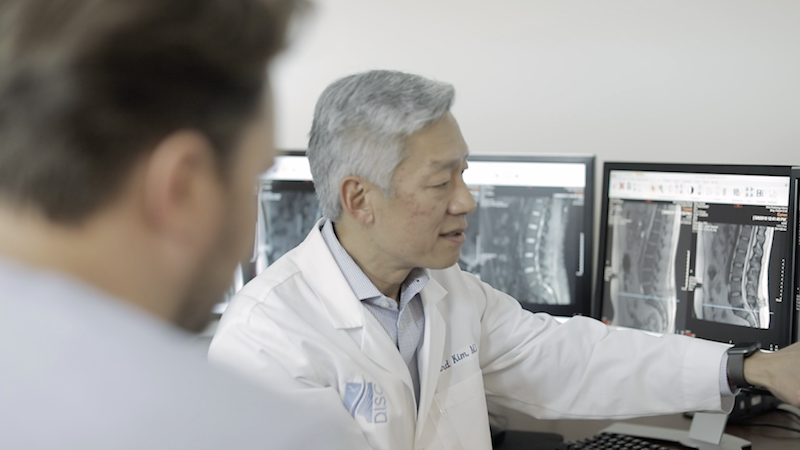
You may know Dr. Richard Kim as a neurosurgeon and spine specialist at DISC Sports & Spine Center. But at DISC, our doctors go beyond just their titles. Did you know, for example, that Dr. Kim loves wine and has a sommelier certification? Or that he’s an athlete himself?
In an effort to get to know Dr. Kim a little better, we asked him the following fun questions:
What is your favorite hobby?
Dr. Kim: My favorite activity outside of family and work is cycling. I started 25 years ago when I started to have issues with my knees from running. I started riding the trails around Orange County with my wife and friends and fell in love with it. I learned more about mountain biking, equipment, and training. I started doing local races and doing well in them, so I joined a team and raced regularly. I also supported our local teams and clubs. I do a lot of road riding as well, which is a completely different sport than mountain biking. The cycling community in OC (and across the world) is vibrant and supportive.
Give us one interesting fact about yourself that someone might not know.
Dr. Kim: I’ll just say that I have a love of wine. I received my Sommelier Level 2 certification a few years ago to enhance my appreciation of wine and build my base of knowledge. I have a pretty decent collection in my home cellar and love sharing good wine with friends.
Why did you choose to go into medicine?
Dr Kim: I knew I wanted to go into medicine, and specifically surgery, at a very young age. In high school, I began to learn more about the field of neurosurgery, and in college I shadowed neurosurgeons in clinics and operating rooms. As I learned what neurosurgery was really about and the hard work and sacrifices that go into its training and daily practice, I became more certain this was what I wanted to do. I was fascinated by the idea that we could use our knowledge to help people get better and that a surgeon could use his or her hands to create a cure. It’s a profound privilege.
What’s your philosophy for treating patients?
Dr. Kim: I think it’s essential when treating patients to use an individualized approach for each patient. While it’s true that certain conditions share common features and modes of treatment, there are differences between patients. These may be subtle or large, but in order to understand a patient’s condition, the physician needs to understand the variations in features that cause that particular person’s signs and symptoms. The solution then should be tailored for that situation. I view this as an approach that starts at square one and builds a complete picture piece by piece. The surgical options also need to be weighed according to the person’s condition. An anterior approach may be best for one person, but a lateral approach may be best for a different person. Someone else may not need a fusion at all, only a quick decompression. Surgeons have a saying: “If all you have is a hammer, then everything looks like a nail.” My approach is to define the problem and the best solution, then pull out the tools you need for the job.
What is the top health tip you tell all your patients?
Dr. Kim: My top health tip for patients is to take care of yourself, both physically and mentally. This means getting up and doing as much exercise as you can handle. This may mean a walk around the block before you’re exhausted, and that’s 100 percent OK because it’s better than not getting out that day at all. It also means taking care of yourself emotionally. Whether you’re recovering from surgery or dealing with chronic illness, it’s important to accept your circumstances and have goals and a plan going forward. Take care of others if you can, and take time out for yourself to take a break or do something fun. This will energize both body and soul.
Dr. Kim has been a neurosurgeon in Orange County for more than 20 years. Both natives of southern California, he and his wife completed their medical training together, traveling throughout the country for medical school, residency, and fellowship. Ultimately, a faculty position at UC Irvine brought Dr. Kim back to California.
In addition to working as a surgeon at DISC Sports & Spine Center, Dr. Kim is involved with several professional organizations, including the American Epilepsy Society and the American Association of Neurological Surgeons.
Dr. Kim is an avid cyclist and has even won a few California state championships in mountain biking. Being an athlete allows him to relate to the active nature of his patients, understanding the difficulties they encounter when symptoms affect their activity and prevent them from doing what they love. He believes this helps him set goals with his patients, working to develop the most conservative treatment plan that will still allow to get them back to their sport as quick as possible.
Dr. Kim knows sometimes the hardest part of surgery for his patients is simply the anticipation, so he actively works to put his patients at ease by preparing them on what to expect with the procedure and their post-op recovery. He states, “It’s satisfying to see patients come through surgery and feel not only better physically, but better emotionally.”



