
Dr. James Chen is a highly skilled orthopedic surgeon who was enlisted by DISC to bring a best-in-class total joint replacement program to its renowned DISC Surgery Center at Newport Beach. Dr. Chen travels around the country to educate fellow surgeons on advanced technology and robotic techniques. Learn more about how Dr. Chen is pioneering the field of robotic knee replacement surgery at DISC:
Robotic Knee Replacement Video:
Robotics and AI in total joint replacements are exciting and rapidly evolving new technologies that are changing the way we approach knee replacements.
As a hip and knee joint replacement specialist, I’ve developed DISC’s joint replacement program with the help of Zimmer Biomet implants and technologies, which include robotics and AI, and are utilized during the entire patient process — not just the surgery itself. These technologies are integrated into patient care from the very beginning, giving us the ability to navigate nuances and personalize plans for each patient’s particular diagnosis, anatomy and mobility goals while optimizing their results.

Advantages and Disadvantages of Robotic Knee Replacements
While robotic assisted knee replacements have many paradigm-shifting advantages, doctors and patients should also be mindful of some of the drawbacks as well. Here are the main advantages and disadvantages:
- Advantages:
- Precision: Robotic systems use advanced imaging and navigation technology to assist surgeons in precisely positioning the implant, potentially leading to better alignment and function.
- Customization: Robotic systems allow for more personalized treatment by enabling surgeons to tailor the procedure to each patient’s unique anatomy, which may result in improved outcomes and faster recovery.
- Minimally invasive: Robotic-assisted surgery can often be performed through smaller incisions compared to traditional surgery, which may lead to less tissue damage, reduced pain, and faster recovery times.
- Enhanced Visualization: Robotic systems provide surgeons with detailed, real-time feedback during the procedure, allowing for better visualization of the surgical site and more accurate placement of the implant.
- Reduced Risk of Complications: The precision and accuracy of robotic systems can help minimize the risk of complications such as implant misalignment, instability, and premature wear.
- Disadvantages:
- Learning Curve: Robotic knee replacements are extremely complex ––surgeons must undergo additional training before deploying robotics during knee replacement procedures.
- Access and Availability: Robotic-assisted knee replacement may not be widely available at all healthcare facilities, limiting access for some patients. Only the most advanced facilities, like DISC’s ASCs, have the space, capital, infrastructure and expertise to house the equipment needed to perform robotic knee replacement surgeries.
- Cost: Robotic-assisted surgery can be more expensive than traditional knee replacement surgery due to the initial investment required for the equipment and ongoing maintenance costs.

Robotic Knee Replacements Allow for More Customization
One of the major issues we faced before a wider availability of implants came to the market was that we would often have to make sacrifices, like using an implant that was a little bigger than we would have liked. But that’s now a problem of the past, because we’re able to match customizable patient plans with custom implants based on the patient’s anatomy. Zimmer Biomet implants, for example, come in sizes that vary by 1-2 millimeters, with variations in sizes for right, left, wide and narrow, so surgeons can get a patient’s imaging done beforehand and map out their anatomy with robotic technology to come up with a plan and a set of implants without making any sacrifices.

ROSA Robotic Knee Replacements: Data-Driven Decision-Making
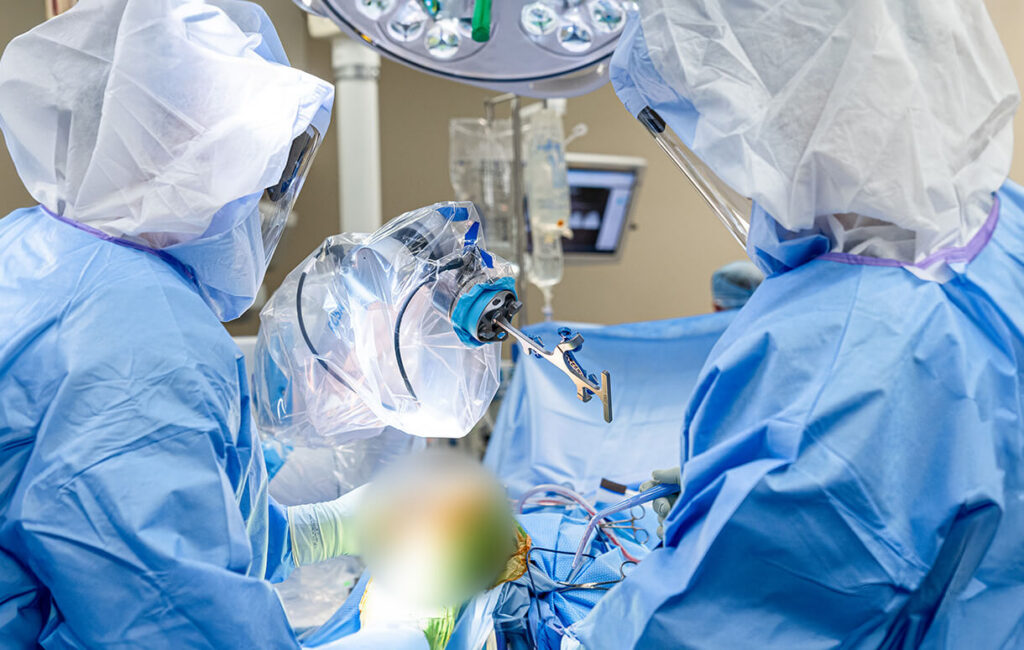
Another way we incorporate robotics into our procedures at DISC is during the procedure by using Zimmer Biomet’s ROSA Knee System, which combines the customized implants with personalized surgical procedures for my patients. ROSA Knee is a robotically-assisted surgical system designed to help perform total knee replacement surgery, and can assist surgeons with bone resections and assessing the state of soft tissues in order to facilitate implant positioning intraoperatively. I’m able to take data provided by ROSA Knee and use it to inform my decision-making during the operation, while also using computer and software technology to control and move surgical instruments, which gives me greater precision and flexibility during procedures.
Technology Ecosystems For Pre- and Post-Op Care
The most exciting advancement in robotic technology is that it’s not just a standalone tool to use during surgery — we’re building out ecosystems so many different technologies can share data with each other and improve the way patients are cared for before and after procedures. With Zimmer Biomet’s mymobility® app, we can send education and therapy reminders directly to our patient’s cellphone and monitor our patients’ activity levels throughout the days and weeks while they are preparing for and recovering from surgery. This is a game changer for patients because we’ve found that when patients receive procedure-specific information at the appropriate time, they better understand their condition and can take an active role in their care.
Zimmer Biomet also makes a smart knee implant called the Persona IQ, which works with the mymobility® app and has implantable sensor technology that records and wirelessly transmits a wide range of gait data from the knee implant to a patient’s personal base station at home. The data is then securely delivered to a HIPAA compliant cloud-based platform and can be accessed by the patient and their surgeon. This innovative technology allows me to check in on my patients using data that neither of us would have had access to before.
Artificial Intelligence Helps Predict How to Treat Patients
DISC’s use of advanced technologies in orthopedics is not only limited to robotic knee replacements; we use AI and data analysis strategies to enhance patient care. By collecting patient data from the Persona IQ smart knee implant, we’re able to match patients into cohorts with similar patients to them, and we’re training AI algorithms to help guide patients in the post-operative setting. This will grant us useful predictions for how we can better treat any particular patient. For example, if we predict that your gait speed is progressing as normal, but you aren’t walking as much as patients in your cohort, we get a notification and can reach out to the patients before they have to reach out to us to let us know something is happening. It greatly improves our access to patients from afar, which ultimately helps improve the quality of care we are able to provide.
I feel honored to be able to offer personalized patient care for knee replacement surgeries using the latest technologies in a less-stressful outpatient setting, and in a facility that specializes in these types of cutting-edge procedures. At DISC, our methods are continuously evolving and improving over time as these technologies improve, and as we hone in on the best processes for each individual patient.
Schedule an appointment with Dr. Chen today.



