
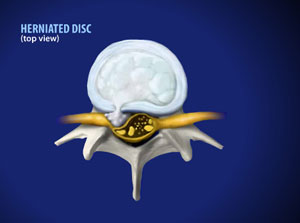
Many people have to deal with a herniated disc at some point in their lives. Such a condition gets exacerbated by age and other factors. If you work in a profession that requires you to sit all day, for instance, you could be more likely to herniate an intervertebral disc. Repetitive motions can take their toll, as can not achieving the proper form when lifting weights.
What Does Having A Herniated Disc Actually Mean?
Learning how to deal with a herniated disc first requires an understanding of exactly what the condition is in the first place. Think of your intervertebral discs as the cushions that rest between each section of your spine. When these are healthy, they allow for spinal mobility and take some of the impact that would otherwise reverberate throughout your spine on a daily basis.
These intervertebral discs are essentially made up of two components: the inner nucleus, which is fluid, and the outer annulus, which is made up of tougher cartilage. Over time, or because of some sort of trauma, the nucleus can push through the annulus. This is what is referred to as a herniated disc.
The Impact Of A Herniated Disc
Someone suffering from such a condition might experience a host of complications, depending on how extensive the hernia itself is. Because of the sheer number of nerve endings in the area of the annulus, any tear of this material is going to cause your body to feel pain in the vicinity. This will typically be marked by inflammation.
A herniated disc can also lead a person to experience sciatica. When the disc is herniated, it can actually begin to push on the spinal cord and the nerve roots attached to that section of the spine. Because these nerve roots are responsible for feeling in the lower body, a person suffering from the condition may find oneself feeling pain in the lower back all the way down to the buttocks and legs. If this pain progresses to a burning or tingling sensation and finally graduates to numbness, then it is imperative that the issue be addressed to by a medical professional right away.
Your Surgical And Non-Surgical Options

Most patients have a few options to consider depending on the severity of the herniation they suffer from. If the damage is minor, the herniation could go away of its own accord. This process can be aided with a rehabilitation program that encourages healing and back health. Med-X specific spinal strengthening is one such program.
Basic anti-inflammatory drugs are another option when the damage is not yet sufficient to provoke a surgical response. Corticosteroid injections may also help in this regard. For those looking for alternative therapies, acupuncture provides relief to many experiencing this condition.
For some, though, conservative treatment modalities are not sufficient to address herniated disc related pain and potential nerve damage. If numbness, pain and weakness are commonplace, to the point where your quality of life is actually being affected, you should give consideration to minimally invasive spinal surgery. A surgeon can go in and repair the damage through such an operation, placing the disc back into its proper place, removing harmful fragments and repairing the annulus wall. Performed on an outpatient basis, a patient undergoing a minimally invasive spine surgery at DISC are able to return home the same day of surgery and experience a rapid recovery. After surgery, physical therapy and conservative treatment is available through The Soft Tissue Center to help patients recover fully, build strength and stability, increase flexibility and range of motion and avoid future injury.


